Friday, October 29, 2010

The Gospel According To Jesus

Chris Seay, pastor and president of the Ecclesia Bible Society, has written an interesting book, in which he tries to help modern Christians embrace the authentic Christian life. He titles the book: The Gospel According to Jesus, but a more appropriate name would be: The Gospel of Jesus According to Paul.

The book centers on understanding Jesus through the lens of the Epistle of Paul to the Church at Rome. According to Seay, true Christianity is about restoring what is broken. He suggests that 84% of Christians misunderstand the meaning of the word “righteousness” and this failure leads to a distorted understanding of the message of Jesus.

The Gospel message is all about restoring our sinful ways, not about a social gospel or personal piety. Jesus came to bring life and light into the dark corners of our lives. This vision is one that is then played out in all aspects of our lives; from the restoration of broken marriages, to care for creation.

The book is well written, although there is some material that is missing on page 74. His arguments are well constructed, as long as your understanding of the Biblical material is the same as Seay’s. Which is not a literal understanding, but at times it does not seem far from it.

The book is meant to counter some of the more progressive understandings of the Gospel that are presented by other authors. What I found frustrating, is it really has very little to do with Jesus, as his contemporaries would have understood him, but the understanding that Paul begins to construct 20 or 30 years after the death and resurrection of Jesus. With that understanding, it is well done. But it is not really the Gospel of Jesus.

Disclosure of Material Connection: I received this book free from the publisher through the BookSneeze.com book review bloggers program. I was not required to write a positive review. The opinions I have expressed are my own. I am disclosing this in accordance with the Federal Trade Commission’s 16 CFR, Part 255 : “Guides Concerning the Use of Endorsements and Testimonials in Advertising.

Tuesday, September 28, 2010

Great story -- Lousy Movie!

We have often heard the phrase: “Leaders are not chosen, they are called.” The Least Among You, a new movie by first time director Mark Young, is inspired by the true story of Richard Kelly. Kelly was arrested in the 1965 Los Angeles Watts riots and is sentenced to serve probation at an all-white seminary. Kelly is encouraged to break racial boundaries by the seminary president Alan Beckett. Unfortunately, what Kelly discovers is that the school wants black followers not leaders. Even former missionary, Kate Allison initially rejects him. With a prison sentence looming, Kelly meets the gardener, and his life is forever changed.

It is a great story – unfortunately it is a lousy movie. The acting is poor, the editing is questionable at times and the whole thing just bogs down. Why is it that “Christian movies” always seemed to be a step behind the other offerings that Hollywood has? It certainly isn’t because of the story, because this one is powerful.

After watching the movie, I am inclined to go read the book, but I am not sure if one exists. I loved the story, but I cannot recommend this movie.

Disclosure of Material Connection: I received this book free from the publisher through the BookSneeze.com book review bloggers program. I was not required to write a positive review. The opinions I have expressed are my own. I am disclosing this in accordance with the Federal Trade Commission’s 16 CFR, Part 255 : “Guides Concerning the Use of Endorsements and Testimonials in Advertising.”

Friday, September 10, 2010

Another Lucado book

Max Lucado's newest book, Out Live Your Life: You Were Made to Make a Difference, is his best book in my opinion, but it doesn't fall too far from the rest of his books.  The premise of the book is just as the title suggests, that everyone can make a difference in life IF they make the choices to do so.  I love the concept and the idea --- it was the execution that bothered me.

The book is a very fast read, it can be done in a couple of sittings, and that may be part of the problem.  The issues that Lucado attempts to challenge us with are significant and deep and required more that the cursory look that he gave them.  There are many systemic problems in the world today, and while it is easy for us to, as Lucado suggests to feel overwhelmed and as a result do nothing --- there are many, many little things that we can all do to make a huge difference. 

At times, this book felt like somebody gave Lucado an idea and only a few weeks to throw a book together.  It seemed hurried and could have gone into more depth.  In Lucado's defense -- I am not his audience.  Lucado writes to an audience that does not want to dig too deep beneath the surface.  They want truths and not gray areas.  Unfortunately, I live in the gray of life and so this book is way too simplistic for me.

This book would be great for somebody who is looking for simple answers in how to move out of their comfort zone and begin living the life Jesus invited people to live.

Disclosure of Material Connection: I received this book free from the publisher through the BookSneeze.com book review bloggers program. I was not required to write a positive review. The opinions I have expressed are my own. I am disclosing this in accordance with the Federal Trade Commission’s 16 CFR, Part 255 : “Guides Concerning the Use of Endorsements and Testimonials in Advertising.”
Tuesday, September 07, 2010

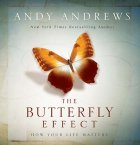
The Butterfly Effect

Andy Andrews, much sought after speaker and NY Times best-selling author has written a short inspirational story bases on the idea that “Every single thing you do matters. You have been created as one of a kind. You have been created in order to make a difference. You have within you the power to change the word.” The book, The Butterfly Effect, is an extremely short book telling the story about a decision that Colonel Joshua Lawrence Chamberlain made during the battle of Gettysburg during the Civil War. Andrews suggests that this single decision changed the outcome of the war and ultimately changed the world.

We could argue for hours about whether that statement is true (his notion is much too simple), or we could look at the bigger picture of what Andrews is suggesting. His premise is based on a hypothesis that Edward Lorenz presented in 1963 that a butterfly could flap its wings in China and start a hurricane on the other side of the planet. This theory is a part of the larger chaos theory and has some validity, but is much more complex than Andrews portrays in the book.

While saying all of this, the book was wonderful. Regardless of whether we all can have an impact in changing the world, Andrews reminds us that we can make a difference, which is something that we all need to hear. Our lives, individually and collectively do matter and we should all be seeking to leave a lasting legacy.

My biggest complaint with the book has to do with its size relative to the price. At $14.95 you are paying a lot for each word that Andrews writes. This is a book that you can read in 10 or 15 minutes, and is not one that I would ever see myself purchasing. Now that I have a copy, I am sure that I will share it with some people.

Disclosure of Material Connection: I received this book free from the publisher through the BookSneeze.com book review bloggers program. I was not required to write a positive review. The opinions I have expressed are my own. I am disclosing this in accordance with the Federal Trade Commission’s 16 CFR, Part 255 : “Guides Concerning the Use of Endorsements and Testimonials in Advertising.”

Wednesday, September 01, 2010

Robert E. Lee

Robert E. Lee is many things to many different people, often determined by where you happen to live in the United States. But to anybody who has studied the Civil War, Robert E. Lee is quite possible the greatest general to have ever lived. John Perry has written a brief history of Robert E. Lee, from his childhood to his greatest moments as general of the Confederate Army, to his last years as President of Washington University.

Lee: A Life of Virtue is a part of Thomas Nelson’s The Generals series. The goal of the series is to cut through the pro or negative opinions on Lee and give an unbiased account of his life. Unfortunately, with a personality like Lee, I am not sure that is possible. Perry does an excellent job in sharing the story of Lee for somebody who does not know much about him or the Civil War. I would not recommend this for anyone who wants to dig deep into the life of Lee and his role during the Civil War. Having read Freeman’s classic four volume series on Lee, there was nothing new or surprising in this text.

As I read the book, I thought that it would be an excellent introduction to Lee for a Middle School level class. The writing style is excellent for a younger audience and the book is not filled with footnotes (which I missed!, and a more scholarly study would require). Overall, with the understanding that this book is meant for a younger reader or someone with little or no understanding of the Civil War, I would highly recommend it.

Disclosure of Material Connection: I received this book free from the publisher through the BookSneeze.com book review bloggers program. I was not required to write a positive review. The opinions I have expressed are my own. I am disclosing this in accordance with the Federal Trade Commission’s 16 CFR, Part 255 : “Guides Concerning the Use of Endorsements and Testimonials in Advertising.”

Wednesday, August 04, 2010

Jesus Wars

On this same trip to the bookstore, I also came across Philip Jenkins newest book, The Jesus Wars:  How Four Patriarchs, Three Queens, and Two Emperors Decided What Christians Would Believe for the Next 1,500 Years, a rather interesting if not uneven telling of the history of the early church.  It pretty much begins following the council of Nicea and continues for the next 500 years or so.  The focus of the book is on the struggle to define who Jesus is (was).  Was Jesus a man-bearing God, or a God-bearing man?

The book was fascinating, but at times got lost in minutia.  Overall, I enjoyed the way that Jenkins' laid out the struggle of the early church to define orthodoxy.  His writes with the style of education, which makes the book less accessible to an average audience.

Having read Richard Rubenstein's work: When God Was Born, a number of years ago, I found his treatise of the years leading up Nicea as more engaging.  Jenkins' argues that Nicea (identifying Jesus with God) was the easy part --- the challenge was preventing Jesus from becoming entirely God.  That is the subject of the book --- what kind of man was Jesus and what kind of God was he.

We live in such as different time from the one that Jenkins' writes about.  We live with a multiplicity of understanding of who Jesus is (was) and have no fear that the inquisitor will be coming to knock at the door in the middle of the night.  Jenkins' concludes the book by suggesting: "A religion that is not constantly spawning alternatives and heresies has ceased to thing and has achieved only the peace of the grave."

I can rest easily knowing that I am doing my part to helping people see some of the alternatives than those proclaimed at Chalcedon and the following councils!

American Moses

I was browsing at the Book Store that Cokesbury sets up at annual conference in June and saw this book by Bruce Feiler and was intrigued.  I have to admit that everything that I have read from him so far (Walking the Bible, Where God Was Born, Abraham) have been wonderfully written and powerful books that have gripped me and challenged me in my own walk with God.  I re-read (or listen to) walking the Bible every time I get ready to head back to Israel and strongly encourage all those that travel with me to do the same.  The title of the book alone: America's Prophet: Moses and the American Story, peaked my interest.  I was not disappointed.

Feiler argues that throughout the history of the United States you will find the Exodus story and that we have had the repeated need to raise up American Moses'.  The book begins with the Pilgrims off Massachusets coast, quoting the story.  They saw themselves as the new Israelites fleeing bondage in the old world and escaping to set up God's kingdom in the new world.

But the story doesn't end there.  The founding fathers (Franklin and Jefferson) suggested that Moses should be a part of the great seal of this new country.  The Liberty Belll has words from Moses inscribed on it.  Both Washington and Lincoln were called Moses incarnate.  Martin Luther King invoked the image of Moses the night before he was murdered.  And many see Barak Obama as a new Moses as well.

But the real point of Feilers book is a call for us to re-examin our lives and our priorities as a country.  He is calling us (as any good preacher would do) to re-evaluate our priorites before it is too late. 

Feiler is a master story teller and I would highy recommend this book!

Thursday, July 22, 2010

Beyond Opinion

I knew better than selecting this book: Beyond Opinion: Living the Faith we Defend, by Ravi Zacharais, to review, because the worldview of the authors and my worldview are completely different. We both are Christians, but we understand the nature and role of Christianity in a completely different way. That said, if your worldview is the same as the authors, you will find this book to be very helpful as you develop the skills and comfort level to defend and promote this brand of Christianity.

It is a well written, at times engaging book designed to help Christians begin to become comfortable with the responsibility of defending the faith. They cover a large group of topics including:
  • Postmodernism and their challenges to Biblical authority
  • Atheism
  • Islam
  • Evil & suffering
Overall, since the book was written by 13 different authors, it reads very well. The quality of the chapters was uneven, but not surprising since each chapter was written by someone else. The editing is very good to keep the style consistent.

I have to admit. There were many times when I laughed out loud at the ridiculous arguments that they made. If you are reading this from a differing world view you will find the book rather trite. But I enjoyed reading the argument for this brand of faith from “the world’s leading Christian Apologist. It certainly gave me insight into the blinders that they put on, as well as my own.

Disclosure of Material Connection: I received this book free from Thomas Nelson Publishers as part of their BookSneeze.com book review bloggers program. I was not required to write a positive review. The opinions I have expressed are my own. I am disclosing this in accordance with the Federal Trade Commission’s 16 CFR, Part 255 : “Guides Concerning the Use of Endorsements and Testimonials in Advertising.”

Wednesday, June 16, 2010

Review of "A Guy's Guide to Life."

I was excited when I picked up A Guy's Guide to Life: How to Become a Man in 224 Pages or Less, the prospect of a book that really was willing to deal with the issues that a teenager encounters growing up, would be invaluable. Jason Boyett’s writing style is witty and engaging. And the book is filled with lots of great tips on helping a person navigate the teenage years.

Unfortunately, the book is also trite. I was hoping that this would be something that I could give to my teenage daughter’s boyfriends, but they would be too busy laughing at the silliness of some of the suggestions to really hear the important stuff.

The biggest problem for me is the book doesn’t really exist in the real world. It is a world that the youth that I know don’t live in – nor did they ever.

Disclosure of Material Connection: I received this book free from Thomas Nelson Publishers as part of their BookSneeze.com book review bloggers program. I was not required to write a positive review. The opinions I have expressed are my own. I am disclosing this in accordance with the Federal Trade Commission’s 16 CFR, Part 255 : “Guides Concerning the Use of Endorsements and Testimonials in Advertising.”

Friday, November 06, 2009

Celebration Church

The night of November 11th, 1989 was one of the longest in my life. Twice in the night, I had to get up and run to the local YMCA to hit the over-ride switch on the heating system. As I would lie in bed, sleepless, I worried about the events of the next day.

  • Would anybody come?
  • Would anybody stay?
  • What in the world had Nancy and I (and one year old Jessica) gotten ourselves into?
My clearest memory of that weekend, however is not about the smelly tarp the Y made us put down to protect their gym floor; nor about the people we met on the phone who volunteered to help that first Sunday by bringing cookies or helping welcome people or work in the nursery. My clearest memory is of leaving the Y, the evening of the 11th, after a downpour and seeing in the sky a beautiful rainbow. It was if God was saying; quit worrying, everything is going to be OK.

We made lots of mistakes right off the bat, but somehow, we eventually got it right. We stopped trying to be “a traditional church that reached young people,” and instead, for United Methodists at the time, became a rather unique church. So much so, that Church Growth Expert Lyle Schaller came to visit, and wrote about Celebration Church in one of his books. Divorce Recovery Workshops, Rock and Roll music, and a weird Coffee Break, all became signature items at Celebration Church.

It is interesting to look back 14 years removed from the experience. Without a doubt, the experience of starting Celebration Church transformed me, and began the journey that continues to this day of experiencing and sharing a God who is not only there, but a God who is real.

It was at Celebration Church that I began allowing my “progressive theology” to openly come to the surface. It was through leading dozens of divorce recovery workshops, that I was forced to wrestle with much of the traditional theology of Christianity regarding broken people. And I will never forget, when we made the transition from being a “traditional” church to a more progressive one, and we used a modern version of the Lord’s Prayer and someone complained by saying to me: “If it, (the King James Version of the prayer) was good enough for Jesus, it was good enough for her.” I hadn’t realized that Jesus spoke King James English!

I learned quickly, that I could not please everyone, and that the vision, was what had to be held at the center --- not our own individual desires or wishes. That was a tough lesson, but one that has served me well over the years. As I have often said: “It’s not about you,” I learned that it also was “Not about me!” I may have been responsible for the vision, but it could never be my vision, it had to be God’s!

Creating a church that spoke to “young people”, and remain in the rubric of the United Methodist Church was a challenge in 1989 (it still is today), but I am proud when I think of all the young lives that came to know God through the experience of Celebration Church.

I have come a long way since those heady days of my youth. My children are mostly grown and soon will be on their own. I have learned to be even more comfortable in my skin and with my relationship with God. I am more passionate about the radical love that Jesus modeled for the world, and well aware of the costs of following that radical love.

As Celebration Church celebrates their 20th birthday this weekend, I wish them well, and pray for continued success in the future.